
From Procrastination to Productivity: A UK Student’s Guide to Mastering Deadlines
The transition to university life in the UK often feels like a sudden leap into a deep ocean of independence. Between the social buzz of campus life and the intellectual rigors of undergraduate study, the most common enemy students face is the clock. Procrastination isn’t just about being lazy; it is often a response to the overwhelming pressure of a mounting workload. When you are staring at a blank screen at 2:00 AM with a deadline looming, the stress can feel paralyzing.
In these high-pressure moments, many students realize that academic success isn’t just about working harder, but about working smarter. While building your own research skills is the ultimate goal, there are times when the sheer volume of modules becomes unmanageable. This is where professional academic support can play a role in a balanced study strategy. For instance, many high-achieving students decide to write my assignment through specialized services when they need to understand the structural blueprint of a complex essay or when personal circumstances limit their study hours. Utilizing such resources allows you to visualize a professional standard of work, which can then be used as a foundation for your own future projects.
The Psychology of “Why We Wait”
Understanding why we procrastinate is the first step toward beating it. For most undergraduates, procrastination is a “perfectionist’s shield.” If you don’t start the essay, you can’t fail at it—at least not yet. This cycle creates a false sense of security that eventually leads to a frantic, low-quality rush toward the finish line.
To break this, you must shift your mindset from “completing the task” to “starting the task.” The goal shouldn’t be to write a perfect 2,000-word paper in one sitting; it should be to write 50 words right now. By lowering the barrier to entry, you trick your brain into bypassing the fear of failure.
The Power of Time Blocking and the Pomodoro Technique
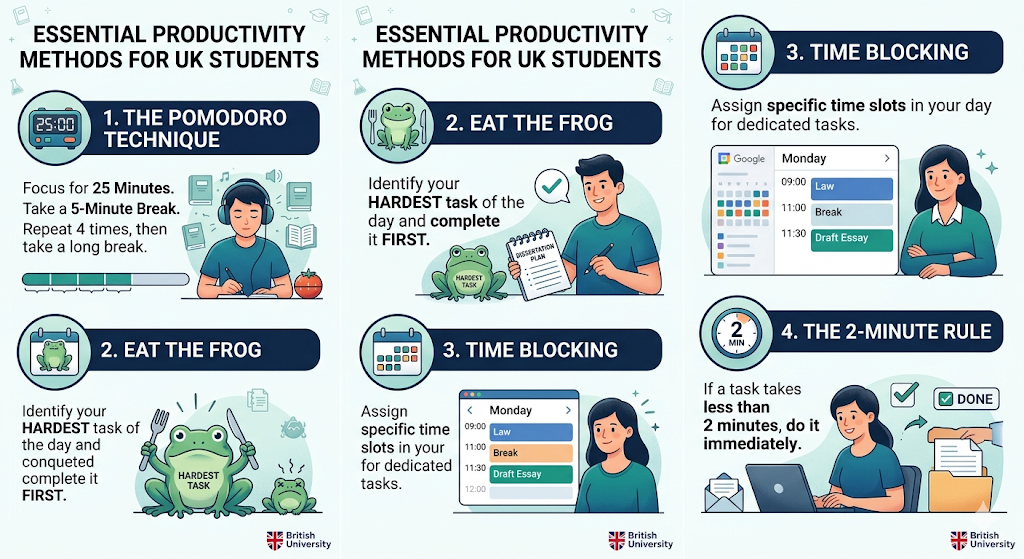
One of the most effective ways to manage a heavy UK university curriculum is through Time Blocking. Instead of a vague “to-do list,” you assign specific hours of your day to specific tasks. For example:
- 9:00 AM – 11:00 AM: Research for Law module.
- 11:00 AM – 11:30 AM: Break.
- 11:30 AM – 1:00 PM: Drafting the introduction.
A popular subset of this is the Pomodoro Technique. You work for 25 minutes with total focus, followed by a 5-minute break. After four cycles, take a longer 30-minute break. This keeps your brain fresh and prevents the “burnout” that usually leads to scrolling through social media for hours.
Comparison of Productivity Methods
| Method | Best For | Effort Level | Key Benefit |
| Pomodoro | Short-term focus & tasks you dread | Low | Prevents mental fatigue |
| Eat the Frog | Tackling the hardest task first | High | Removes the day’s biggest stressor |
| Time Blocking | Complex schedules with multiple modules | Medium | Ensures every subject gets attention |
| The 2-Minute Rule | Small admin tasks (emails, filing) | Very Low | Clears the “clutter” from your mind |
Maintaining Academic Integrity in a Digital World
As you move into the middle of your semester, the pressure to produce original, high-quality content increases. With the rise of digital resources and AI-assisted research, maintaining the “Experience, Expertise, and Trustworthiness” (E-E-A-T) of your work is vital. Universities in the UK, USA, and Australia are more vigilant than ever regarding the authenticity of student submissions.
Professionalism in your writing isn’t just about the words you choose, but the verification process you follow. Even when you are confident in your writing, accidental drafting errors can occur. This is why using a high-caliber plagiarism checker is a non-negotiable step in the modern academic workflow. By integrating the tools offered by MyAssignmentHelp, you ensure that every citation is accurate and that your voice remains unique. This level of diligence protects your academic reputation and ensures that your hard work is credited fairly, providing you with peace of mind before you hit the “submit” button on your university portal.
Designing Your Environment for Success
Your physical environment dictates your mental state. If you study in bed, your brain associates that space with sleep, leading to grogginess. If possible, create a dedicated “Deep Work” zone.
- Lighting: Natural light reduces eye strain and boosts mood.
- Ergonomics: A supportive chair prevents the back pain that often cuts study sessions short.
- Digital Minimalism: Use “Do Not Disturb” modes on your phone and block distracting websites during your work blocks.
The Role of Peer Support and Feedback
Don’t be a lone wolf. Undergraduate study is a social experience as much as an intellectual one. Form study groups where you can explain concepts to each other. Teaching a peer is the fastest way to master a subject yourself. Additionally, seeking feedback early—whether from a tutor or a senior student—allows you to course-correct before you’ve invested too much time in the wrong direction.
The “Final Polish” Phase
The difference between a 2:1 and a First-class grade often lies in the final 10% of the effort: the editing. Never submit a first draft.
- Read aloud: This helps you catch clunky sentences that your eyes might skip.
- Check formatting: Ensure your bibliography follows the specific style (Harvard, APA, OSCOLA) required by your department.
- Verify originality: As mentioned earlier, a final scan for technical accuracy ensures your work meets the highest standards of integrity.
Conclusion: Small Steps, Big Results
Academic success is a marathon, not a sprint. By understanding the psychology behind your procrastination, utilizing the right productivity frameworks, and leveraging professional resources when the workload peaks, you can navigate your undergraduate years with confidence. Remember, the goal of university is to learn how to learn. Mastering your deadlines is simply the first step in mastering your future career.
Frequently Asked Questions (FAQ)
Q.1. Is it normal to feel overwhelmed in my second year?
Ans: Absolutely. The “Second Year Slump” is a documented phenomenon where the difficulty of modules increases significantly. This is the best time to refine your time-management strategies.
Q.2. How do I know if my study environment is working?
Ans: If you find yourself frequently checking your phone or losing track of your goals within 15 minutes, your environment likely needs more “friction” against distractions.
Q.3. Why is a plagiarism scan necessary if I wrote the paper myself?
Ans: Accidental plagiarism—such as forgetting a set of quotation marks or incorrectly citing a source—is very common. A professional scan catches these technical errors before they become disciplinary issues.
Q.4. How can I stay motivated during long research projects?
Ans: Break the project into “milestones.” Celebrate completing the literature review or finishing the methodology section. Small rewards keep the dopamine flowing.
Q.5. What should I do if I’ve already missed a deadline?
Ans: Communication is key. Contact your personal tutor or course leader immediately. Many UK universities offer “extenuating circumstances” forms if you have a valid reason for the delay.
About The Author
Hi, I’m Lucy Wilson. As a senior academic consultant and content strategist at MyAssignmentHelp, I specialize in bridging the gap between classroom theory and the practical skills required for professional career readiness.


